In May of 2005, I participated in an experiment of grand proportions. Myself and 5 other artists were given free studio spaces on the 10th floor of an historic building in an area in Brooklyn called DUMBO (Down Under the Manhattan Bridge Overpass). Nestled between the derelict Navy Yard and posh Brooklyn Heights, with some of the toughest public housing projects just blocks away, this area had been an industrial no-man's-land for decades before artists moved in and started setting up studios in the 80's, risking their lives for low rent, and beginning the process of inevitable desirability: gentrification. In exchange for our studio spaces, we all agreed to participate in a collaborative exhibition of our designing which we would present to the public in a multiple day, interactive event. The company that conceived of and hosted the whole thing had long been a theatrical instigator, known for cross-disciplinary performances and over-the-edge experiences. Their most publicized event had been a play called "I'm going to kill the president", the location of which was kept secret until the night of the performance due to a law against saying that sentence. I was thrilled to participate and excited about the event.
In exchange for our studio spaces, we all agreed to participate in a collaborative exhibition of our designing which we would present to the public in a multiple day, interactive event. The company that conceived of and hosted the whole thing had long been a theatrical instigator, known for cross-disciplinary performances and over-the-edge experiences. Their most publicized event had been a play called "I'm going to kill the president", the location of which was kept secret until the night of the performance due to a law against saying that sentence. I was thrilled to participate and excited about the event. Before my installation could begin, I needed to prepare the space. Only recently, it had been a theater with a stage and stadium seating, hosting nightly events on a floor filled with other artists, dancers, and musicians. But then along came development. A new owner meant changes, and this floor was no longer being rented to artists. One by one, all the leases on the 10th floor had expired and all of the spaces had been abandoned to make way for offices instead.
 When I came along, this one space was all that remained, the rest of the walls on the floor had been completely demolished and carted away. The final demolition and next phase of construction was waiting on us. We were literally occupying one tiny box inside a gigantic empty warehouse, to the absolute dismay of the management, who were locked in a drawn out legal battle with the director of the theater. It seems an alternative space had been offered in exchange for vacating the lease but then the offer was rescinded without notice or explanation. Baffled and livid, the theater's director vowed to hold out until the very end, taking the last stand against the artist eating monster that was feasting on the neighborhood. Essentially, we were the last bite left.
 With these circumstances in mind, I approached the installation rebelliously, as we were the final spark of artistic creativity that would occur here before corporate productivity blossomed instead, fertilized by the carcasses of the fallen artists, yet bearing fruits that would be inaccessible to the artists of the future. I began by hanging a sculpture left over from gradschool, New York State from a giant map I'd almost, but not quite, completed. Finishing New York State in New York City was symbolic satisfaction at its purest, and multiple dimensions collided as I constructed the metropolitan area beneath my feet from 5 lotus flowers made from flattened coins.
  Finished, I moved on to my next project. A show in which I'd been invited to participate called for new work, and I knew exactly what I wanted to make. It was to be a dinosaur fossil from car parts, quick, simple, and cool.
I enjoy making some sculptures just for fun, and this was definitely one of those.
 For a moment I put my concerns about the world aside and just made something neat.
  The show traveled next to a different city, meaning the piece quickly left my possession.
 Thus rendered dinosaurless, I set out to create another.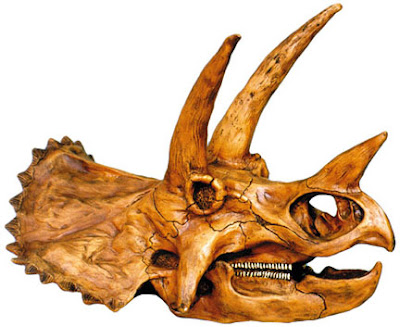
This would be a triceratops, whereas the first had been a tyranosaur. I quickly laid out the parts.
 My studio space was endowed with a terrific view of downtown Brooklyn and the entrance to the Brooklyn Bridge overpass. Not a day passed that I didn't feel lucky about my situation. Streams of automobiles flowed endlessly past in a mesmerizing blur, and often, hypnotized, I would stand and stare.
 One day I observed a banner going up on the building across the street. The building I occupied was practically identical, yet ours was commercial while theirs' would be residential. New neighbors were coming, rich ones: finally convinced that safety in the area at last outweighed the view.
 This was one of many luxury apartment complexes to appear in the neighborhood, the reason that the rents were doubling each year. Only recently the building had also housed artist studios and sweatshops.
 The sign proclaimed "DUMBO's Awesome New Arrival", and featured an elephant and her child. Prime advertising geared at commuters driving over the Brooklyn Bridge, the sign was the final declaration of a different era. Keeping this in mind, I pushed forward on my dinosaur. My installation would be a response to this poster that had appeared in my window.
 The framework for the head was hoisted high into the air, suspended near the ceiling with cables. I wanted my dinosaur to be as massive as possible.
 Eventually the details of the face filled in.
 By this time, I had decided I was going to mirror the poster on the building across the street, using dinosaurs instead of elephants. An old sculpture from my past stepped in to fill the role of the baby dinosaur.
 His mother, looking back over her shoulder, was advancing away from the window. I built her body entirely from sculptures of my own, symbolically identifying the giant creature as a representative of the artists, literally created from art. Mostly I used states: New York was the foundation, Wisconsin the hindquarter, and Kansas, Arkansas, and Mississippi within.
 Her tail ran to an abrupt stop at the window, merging from a certain vantage point to continue onwards as the entrance to the Brooklyn Bridge, alluding to the fact that the other half of the dinosaur spanned the entire river. In effect, I was saying that the affluent newcomers might be the largest living creatures in the neighborhood, but that their extinct predecessors, the artists, had been much greater in their day.
 I quickly laid out the parts.
 My studio space was endowed with a terrific view of downtown Brooklyn and the entrance to the Brooklyn Bridge overpass. Not a day passed that I didn't feel lucky about my situation. Streams of automobiles flowed endlessly past in a mesmerizing blur, and often, hypnotized, I would stand and stare.
 One day I observed a banner going up on the building across the street. The building I occupied was practically identical, yet ours was commercial while theirs' would be residential. New neighbors were coming, rich ones: finally convinced that safety in the area at last outweighed the view.
 This was one of many luxury apartment complexes to appear in the neighborhood, the reason that the rents were doubling each year. Only recently the building had also housed artist studios and sweatshops.
 The sign proclaimed "DUMBO's Awesome New Arrival", and featured an elephant and her child. Prime advertising geared at commuters driving over the Brooklyn Bridge, the sign was the final declaration of a different era. Keeping this in mind, I pushed forward on my dinosaur. My installation would be a response to this poster that had appeared in my window.
 The framework for the head was hoisted high into the air, suspended near the ceiling with cables. I wanted my dinosaur to be as massive as possible.
 Eventually the details of the face filled in.
 By this time, I had decided I was going to mirror the poster on the building across the street, using dinosaurs instead of elephants. An old sculpture from my past stepped in to fill the role of the baby dinosaur.
 His mother, looking back over her shoulder, was advancing away from the window. I built her body entirely from sculptures of my own, symbolically identifying the giant creature as a representative of the artists, literally created from art. Mostly I used states: New York was the foundation, Wisconsin the hindquarter, and Kansas, Arkansas, and Mississippi within.
 Her tail ran to an abrupt stop at the window, merging from a certain vantage point to continue onwards as the entrance to the Brooklyn Bridge, alluding to the fact that the other half of the dinosaur spanned the entire river. In effect, I was saying that the affluent newcomers might be the largest living creatures in the neighborhood, but that their extinct predecessors, the artists, had been much greater in their day.
 To use the Brooklyn Bridge itself as a component of a sculpture a was a unique honor.
 Flattened and fastened into chains, I used pennies to continue the cables of the bridge into my studio. This type of repetition is inherent in all my work.
 As the deadline for the exhibition drew near, my work became more and more fervent, often working all night and staring early the next morning. Certain elements became very deliberate tongue-in-cheek commentary.
 A man I made from dolls holds his nose while pinching the upsweep of the bridge as if it's a soiled diaper, passing judgement on the stinky situation that the new development has created.
 The area below, which corresponds to the East River and also is the stomach of the dinosaur, contains piles of coins, the meager scrapings of the artists who first entered this rough area, inadvertantly causing eventual safety and desirability to ensue.
 Beneath, oozing to the floor, are dinosaur droppings of paper money, the inadvertent biproduct of the artists' existences, to be scooped up later by real estate moguls. On the night of the exhibition, police barred the door and made everyone except the participants vacate the premises. The landlord had filed an injunction against our event, and there was nothing we could do. Approximately 10 people saw this installation, and for less than 15 minutes. Months of effort fizzled down the toilet, the final sputtering attempt to put art above money stomped and squelched. In one moment, another dream was gone.
 DS! (dinoshit)


